

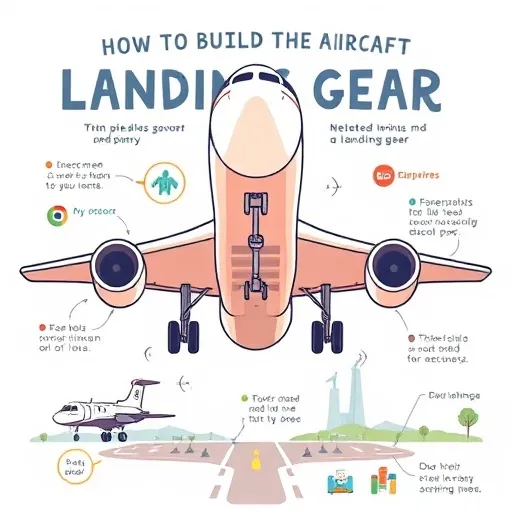
Landing gear core fu
Understanding the Role of Landing Gear in Modern Aircraft
Before you start cutting metal or modeling parts in CAD, you've gotta wrap your head around what aircraft landing gear actually does. At its core, the gear handles three critical jobs: it supports the aircraft on the ground, it absorbs the energy of touchdown, and it enables ground handling like taxiing, steering, and braking. A well-designed system also boosts aerodynamic efficiency by retracting cleanly into the fuselage or wings. Understanding how to build aircraft landing gear starts with grasping these fundamentals.
The load distribution across the gear is one of the first things you'll need to calculate. Static loads, dynamic loads during touchdown, braking forces, and side loads during turns all influence how you design the strut assembly and wheel assembly. Getting this wrong at the start can lead to catastrophic failures later — which is why every serious builder begins with a thorough load analysis. When learning how to build aircraft landing gear, this step is non-negotiable.
Types of Landing Gear Configurations and Weight Distribution Trade-offs
There are several configurations to consider depending on your aircraft type:
- Tricycle gear — the most common layout, with a nose wheel and two main wheels
- Taildragger (conventional) gear — two main wheels forward and a small tail wheel
- Tandem gear — used in gliders and some military designs
- Multi-bogie gear — typical for large commercial transport aircraft
Each configuration has trade-offs in weight distribution, ground stability, and drag reduction. Your choice will shape the entire design process — and it's a big part of figuring out how to build aircraft landing gear that actually works for your specific mission profile.
Preliminary Design and Load Calculations for Maximum Takeoff Weight
The first real engineering step is preliminary design. Here you'll define the aircraft's maximum takeoff weight, landing sink rate, and center of gravity envelope. From these values, you can calculate the design load on each gear leg using standard aerospace engineering methods. This is where how to build aircraft landing gear transitions from theory into numbers.
A good rule of thumb: the main gear typically carries 85–95% of the static load, while the nose gear handles the remainder. But dynamic loads during touchdown can spike to several times the static load — often 2.5 to 3.5 g's depending on sink rate and shock absorber efficiency. You must design for these peak forces, not just the static case. Anyone serious about how to build aircraft landing gear knows that underestimating these spikes is a recipe for disaster.
At this stage, you'll also choose your kinematic architecture — whether the gear is fixed, retractable, or partially retractable. Fixed gear is simpler and lighter but adds parasitic drag. Retractable gear improves cruise performance but requires actuation systems, hydraulic lines, and additional structural reinforcement.
Material Selection for Landing Gear Components and Fatigue Resistance
Material choice is arguably the most consequential decision in the entire build. Landing gear must be strong, fatigue-resistant, and lightweight — three properties that often compete. In 2026, the materials science landscape offers excellent options, and knowing how to build aircraft landing gear means knowing which material fits which component:
- High-strength steel alloys (such as 300M and 4340) — classic choices for struts and axles due to their fatigue resistance and toughness
- Aluminum alloys (like 7075-T6) — used for lighter structural components and torque links
- Titanium alloys — increasingly popular for weight reduction in high-performance applications
- Carbon-fiber composites — used in fairings, doors, and some non-primary structures
- Additive manufacturing — 3D-printed metal parts for complex brackets and fittings are now common in 2026
Material selection should always be driven by stress analysis and fatigue life predictions, not by convenience. Consult industry standards and certification requirements early — some materials are far easier to certify than others. This is a lesson every engineer learns when figuring out how to build aircraft landing gear for real-world certification.
Designing the Strut and Shock Absorption System with Oleo-Pneumatic Efficiency
The shock absorption system is the heart of any landing gear design. Its job is to dissipate the kinetic energy of touchdown without transferring excessive loads into the airframe. There are three main approaches:
Spring-type shock absorbers: Simple steel spring or rubber compression systems work for light aircraft. They're cheap, reliable, and easy to build, but they lack the energy dissipation of hydraulic systems and can rebound harshly.
Oleo-pneumatic (hydraulic) struts: The gold standard for most aircraft. An oleo strut combines a gas spring (usually nitrogen) with hydraulic fluid that passes through an orifice during compression. The fluid dissipates energy as heat, while the gas provides the spring force. Designing an oleo strut requires careful attention to orifice sizing, fluid viscosity, and seal integrity — core skills for anyone mastering how to build aircraft landing gear.
Trailing-link and cantilever designs: For larger aircraft, trailing-link or cantilever gear arrangements offer better shock absorption and ground clearance. These configurations require more sophisticated kinematic analysis and structural design.
Whichever path you choose, you'll need to model the compression curve and verify it against the design sink rate. Software tools for dynamic simulation make this far easier than manual calculations.
Wheels, Brakes, and Tires for Load Rating and Brake Systems
The wheel assembly is where engineering meets practical ground operations. You'll need to select tires based on load rating, speed rating, and runway surface. Brake systems — typically hydraulic disc brakes for modern aircraft — must be sized to absorb the kinetic energy of a rejected takeoff or a landing roll. This is a critical chapter in how to build aircraft landing gear that performs safely.
Don't overlook the axle design and bearing selection. Wheel bearings must handle radial and axial loads simultaneously and be properly lubricated and sealed. In 2026, many builders are turning to electric braking systems and carbon composite brake discs for weight savings and improved thermal management.
Hydraulic and Actuation Systems with Electro-Mechanical Reliability
If your gear is retractable, you'll need a hydraulic system or electromechanical actuator to move it. Key considerations include system pressure, redundancy, locking mechanisms, and emergency extension capability. Down-locks and up-locks must be robust — a gear that doesn't lock down is a serious safety hazard. Understanding these systems is essential for how to build aircraft landing gear that retracts reliably.
Newer designs increasingly favor electro-mechanical actuation (EMA) over traditional hydraulic systems. EMAs eliminate fluid leaks, simplify maintenance, and improve reliability. That said, hydraulic actuation remains dominant for large aircraft due to its proven power density.
Ground Testing, Certification, and Drop Tests for Structural Integrity
Once your gear is built, the real work begins: testing. Drop tests simulate touchdown loads and verify shock absorption performance. Static load tests confirm structural integrity up to the ultimate design load. Fatigue testing cycles the gear through thousands of simulated landings. No guide on how to build aircraft landing gear is complete without emphasizing this phase.
If you're building under a recognized airworthiness framework, you'll need to demonstrate compliance with regulations such as CS-23, CS-25, or their equivalents. Work with a designated engineering representative or certification authority from day one — retrofitting compliance is far more painful than designing for it from the start.
Common Pitfalls in Load Analysis and Corrosion Protection
- Underestimating dynamic loads — static calculations alone are never enough
- Neglecting fatigue — landing gear is one of the most highly cycled structures on the aircraft
- Ignoring maintenance access — you'll regret a design that requires disassembly to inspect
- Skipping corrosion protection — salt spray, moisture, and deicing fluids attack unprotected metals
- Poor seal design — hydraulic leaks remain the #1 cause of landing gear downtime
How to build aircraft landing gear is not a question with a single answer — it's a systems engineering journey that combines structural analysis, material science, hydraulics, testing, and regulatory compliance. In 2026, new tools like generative design, additive manufacturing, and digital twins are transforming how engineers approach the problem. Whether you're a first-time builder or a seasoned aerospace engineer, the fundamentals remain the same: start with rigorous load analysis, choose materials wisely, design for fatigue, and never skip testing. Master how to build aircraft landing gear the right way, and your gear will do its job safely for decades of landings.